Introduction
For infrastructure owners and facility managers responsible for bridges, dams, ports, and waterfront structures, underwater inspection is not optional — it’s a critical safety and compliance requirement. Yet the traditional approach of sending commercial divers below the surface has remained largely unchanged for decades, despite rising costs, safety concerns, and scheduling challenges.
Today, a growing number of organizations are making the switch to Remotely Operated Vehicles (ROVs) for their underwater inspection programs. But is the technology really ready to replace human divers? And more importantly, does it deliver a meaningful return on investment?
In this article, we break down the real-world differences between ROV inspection and traditional diving, examine the cost structures of each approach, and help you determine which method makes sense for your operation.
The True Cost of Traditional Diving Inspection
When most organizations budget for underwater inspection, they think about the daily rate for a dive team. But the actual cost extends far beyond what appears on the invoice.
Direct Costs
Commercial diving is a specialized, high-risk profession, and compensation reflects that. A typical commercial dive team of 3–5 people can cost $1,500–$5,000+ per day, depending on the scope, location, and depth of work. For deeper dives or hazardous environments, rates can be significantly higher.
Add to that the supporting infrastructure: dive boats, compression equipment, safety standby vessels, and specialized gear. For remote locations, mobilization fees alone can run into thousands of dollars before the first diver even enters the water.
Hidden Costs That Drive Up the Bill
What really blows out the budget are the costs nobody talks about upfront:
- Scheduling delays: Qualified dive teams are often booked weeks in advance, especially during peak seasons. Urgent inspections can mean paying premium rates or waiting.
- Weather dependency: Diving operations are highly sensitive to sea conditions, currents, and visibility. A single weather delay can extend a project by days.
- Decompression limits: Divers can only spend so much time at depth before they must surface and decompress. At greater depths, actual bottom time may be just 20–30 minutes per dive.
- Reporting variability: Inspection quality depends heavily on the individual diver’s experience, fatigue level, and attention to detail. Two divers inspecting the same structure may produce very different reports.
- Liability and insurance: Putting personnel underwater carries inherent risk. Insurance premiums, safety protocols, and incident potential all add to the real cost of diving operations.
According to industry data, the total cost of a traditional dive inspection — including mobilization, equipment, support crew, and reporting — is often 2–10 times higher than an equivalent ROV inspection, depending on the project scope. [^1] [^2]
How ROV Inspection Stacks Up
ROV-based inspection has evolved dramatically in recent years. What was once limited to bulky, ship-deployed work-class systems is now available in compact, portable packages that a single operator can deploy from a dock or small boat.
What Makes ROV Inspection Different?
An ROV is a tethered underwater robot controlled from the surface. It carries cameras, lights, and sensors, and transmits live video and data back to the operator in real time. Modern inspection ROVs like the Run&Win E1 Series offer:
- 4K high-resolution cameras with advanced image enhancement
- MSH (Multi-Source Heterogeneous) vision technology that improves clarity in turbid water
- AI-powered defect detection that automatically identifies corrosion, cracks, and structural damage
- Six-degree-of-freedom control for precise maneuvering around structures
- Extended deployment time — limited only by battery or surface power, not human physiology
The ROV Advantage in Numbers
Real-world case studies consistently demonstrate dramatic improvements over traditional diving:
Metric | Traditional Diving | ROV Inspection | Improvement
——– | ——————- | —————- | ————-
Inspection time | Full dive team, days of work | 1–2 operators, hours of work | ~60% time reduction
Operational cost | $1,500–$5,000+/day | Fraction of diving cost | 50–90% cost reduction
Personnel risk | Divers in hazardous environment | Zero personnel underwater | 100% risk elimination
Data consistency | Subject to diver fatigue & experience | AI-assisted, standardized | Consistent, repeatable results
Deployment speed | Hours of preparation | Deploy in 3–5 minutes | Near-instant readiness
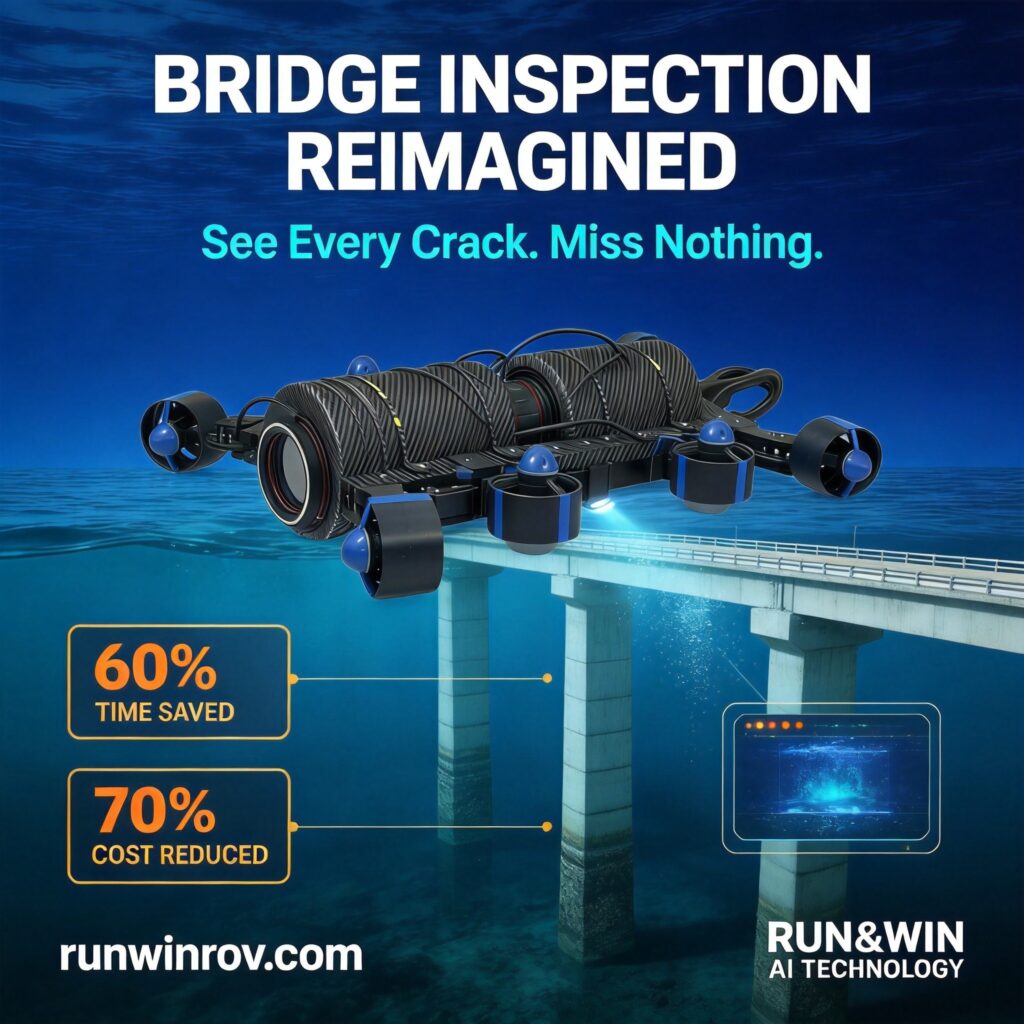
For high-grade waterway bridge inspections in China, Run&Win’s ROV systems have delivered 60% faster inspections at 70% lower cost compared to traditional diving methods, with zero personnel risk and fully digital data records.
When Does ROV Inspection Make the Most Sense?
While ROV technology is powerful, it’s not always the perfect tool for every job. Here’s where it delivers the strongest ROI:
1. Routine & Recurring Inspections
For structures that require regular inspection — bridge piers, port facilities, dam faces, aquaculture net pens — the savings compound over time. One port authority recovered its ROV investment in just 3.2 months by eliminating diver mobilization fees for routine checks. [^3]
2. Hard-to-Reach Locations
Narrow intake pipes, confined spaces, deep-water structures, and areas with strong currents are where ROVs truly shine. Divers face physiological limits at depth; ROVs don’t. Modern compact ROVs can access spaces too small or dangerous for human entry.
3. Time-Sensitive Situations
When a storm hits or an incident occurs, you need answers fast. ROVs can be deployed in minutes from a dock or small vessel, whereas assembling a dive team might take hours or days. In emergency response scenarios, that speed difference can be critical.
4. Data-Driven Asset Management
If you need consistent, comparable data over time — for tracking corrosion rates, monitoring scour progression, or building digital twins of your assets — ROV inspection with AI analytics delivers standardized, repeatable results that divers simply cannot match.
What About the Human Element?
A fair question: if ROVs are so much cheaper and faster, why do divers still exist? The answer is that ROVs excel at inspection and observation, but certain tasks still require human judgment and physical intervention.
Complex repair work, heavy lifting, precision assembly, and tasks requiring tactile feedback remain in the domain of human divers — at least for now.
However, many organizations are discovering that ROVs and divers work best together. An ROV can perform the initial survey, identify problem areas, and guide divers straight to the issues that need hands-on attention. This hybrid approach:
- Reduces diver bottom time and risk
- Focuses expensive dive resources on what humans do best
- Cuts overall project costs while improving safety
- Provides comprehensive digital documentation before, during, and after diver intervention
As one aquaculture industry observer put it: “The optimum use of ROVs is to assist divers in their work. Before a diver so much as gets his toe wet, ROVs can inspect the area, thus saving the diver from using limited underwater time to locate and identify problems.” [^4]
Making the Switch: Getting Started with ROV Inspection
If you’re considering adding ROV capability to your inspection program, here’s how to approach it:
Start with a Pilot Project
Pick one structure or facility that currently requires regular dive inspections. Run a parallel ROV inspection and compare the results in terms of:
- Cost per inspection
- Time required
- Data quality and completeness
- Safety profile
Choose the Right System
Not all ROVs are created equal. For infrastructure inspection, look for:
- Stability in currents: Six-thruster designs with dynamic positioning
- Imaging quality: High-resolution cameras with image enhancement
- Portability: Systems under 10–15 kg that deploy quickly
- Support and service: Access to training, maintenance, and technical support
Train Your Team
Modern ROVs are designed to be user-friendly, but effective inspection still requires proper technique. Look for systems that include operator training and certification.
Build a Business Case
Calculate your current annual spending on underwater inspection services. Then estimate what an equivalent ROV-based program would cost. For most organizations with recurring inspection needs, the payback period is measured in months, not years.
Conclusion
Underwater inspection is evolving, and the shift from human divers to robotic systems is accelerating — driven by economics, safety, and data quality. For infrastructure owners, the question is no longer *whether* ROV technology works, but *how quickly* you can integrate it into your operations.
ROV inspection won’t replace every dive team overnight. But for routine inspections, emergency response, hard-to-reach locations, and data-driven asset management, it delivers superior results at a fraction of the cost — with zero risk to personnel.
The organizations that adopt this technology now will not only reduce their inspection budgets; they’ll build better, more consistent data about their assets, enabling smarter maintenance decisions and longer asset lifespans.
Ready to See ROV Inspection in Action?
Run&Win specializes in AI-powered underwater ROV solutions for infrastructure inspection. Our E1 Series ROVs combine advanced MSH vision technology with AI defect detection, delivering clear, actionable data from structures that were once expensive and dangerous to inspect.
We offer on-site demonstrations, trial programs, and customized solutions tailored to your specific industry and inspection challenges.
Contact Us → to discuss how ROV inspection can transform your underwater asset management program.
*Explore our Case Studies to see real-world results, or learn more about the E1 Series ROV.*
Target Keywords: underwater ROV inspection, ROV vs diving, underwater inspection cost, ROV bridge inspection, port inspection ROV, underwater infrastructure inspection, AI underwater inspection
*Sources:*
[^1]: SepcoTech ROV Applications Knowledge Center — “10× Cost Reduction vs. Divers”
[^2]: Deep Trekker — “Diver versus ROV: Cost-Effectiveness Analysis”
[^3]: Alibaba Electronics Buying Guide — “ROI emerges fastest in recurring inspections”
[^4]: Akva Group — “Will ROVs replace divers in the aquaculture industry?”