Rail Track Bolt Oiling in 2026: Why Automated Robots Are Replacing Manual Maintenance
Railway maintenance faces a $2 billion problem — and most operators don’t even realize how much they’re losing to outdated bolt oiling practices.
Every year, rail networks worldwide spend millions on manual track maintenance. A single maintenance crew can cover only 200-300 meters per shift. The results? Inconsistent lubrication, missed bolts, human fatigue errors, and mounting safety risks.
But in 2026, a new generation of AI-powered rail maintenance robots is changing that equation — and the ROI numbers are hard to ignore.
The Hidden Cost of Manual Bolt Oiling
Most railway operators still rely on manual bolt oiling — workers walking the track with handheld lubrication equipment, applying oil to each bolt individually.
Here’s what that actually costs:
Labor expenses
A typical maintenance team requires 6-8 workers per shift. At average industrial wages, that’s $200,000-$400,000 annually per team — and you need multiple teams to cover extended rail networks.
Coverage gaps
Manual teams can only process 200-300 meters per 8-hour shift. On a 100km rail line, it takes 30+ days to complete a single maintenance cycle. By the time crews return to the starting point, the first bolts are already dry again.
Safety incidents
Workers on active rail lines face constant danger. In 2024, rail maintenance accounted for 18% of all railway workplace injuries globally. Every hour a worker spends on the track is an hour of exposure risk.
Quality inconsistency
Human operators apply different amounts of lubricant based on fatigue, weather conditions, and individual technique. Studies show manual oiling accuracy ranges from 60-85% — meaning 15-40% of bolts receive suboptimal treatment.
Environmental waste
Manual application often leads to over-oiling in some areas and under-oiling in others. Excess lubricant runs off into soil and waterways, creating environmental compliance issues. In regions with strict environmental regulations, this alone can trigger fines of $50,000+ per incident.
What AI-Powered Rail Robots Actually Do
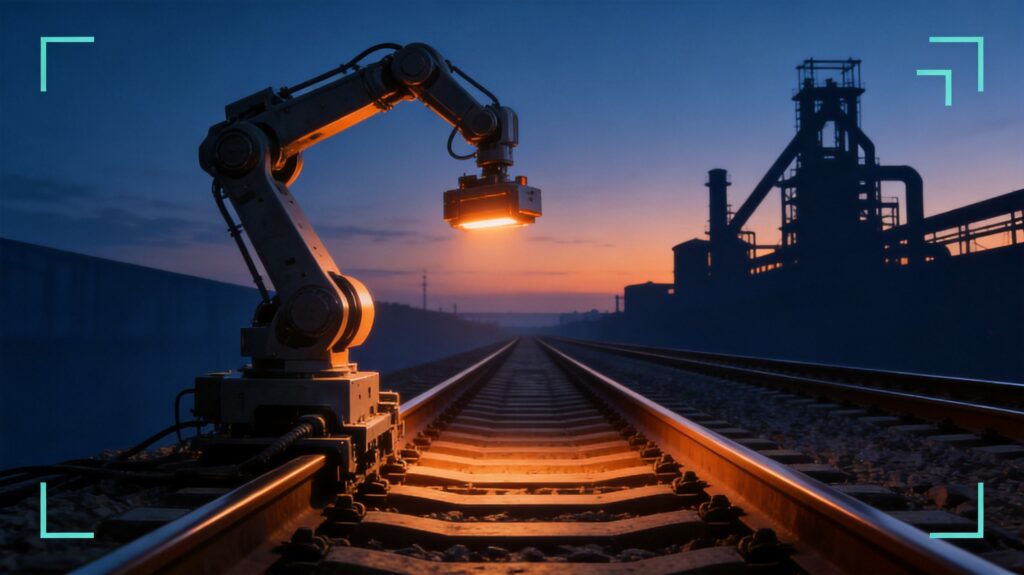
Automated bolt oiling robots like the iRunYu Rail Bolt Oiling Robot use a combination of computer vision, precision robotics, and AI path planning to solve every problem above.
Here’s how the workflow operates:
1. Autonomous navigation — The robot travels along the track using guided rail wheels, no external tracks needed. It self-adjusts to different rail gauges and switch configurations.
2. Vision-based bolt detection — High-resolution cameras and edge AI processing identify each bolt position in real-time, even in low-light or adverse weather conditions. The system distinguishes between bolt types (fish bolts, anchor bolts, elastic clips) and adjusts its approach accordingly.
3. Precision oiling — A robotic arm applies the exact amount of lubricant to each bolt, with accuracy above 95%. Oil volume is controlled to within ±0.5ml per bolt, eliminating waste.
4. Data logging — Every bolt is logged with GPS coordinates, oiling status, oil volume applied, and timestamp. Data exports to standard CMMS formats for maintenance records and compliance reporting.
5. Anomaly detection — The vision system simultaneously scans for bolt damage, corrosion, and missing fasteners — flagging issues before they become failures.
The result: one robot replaces 8 manual workers, covers 10x the distance per shift, and maintains 95%+ oiling accuracy consistently.
The Real ROI: Numbers That Matter
Let’s break down the economics for a typical 500km rail network:
| Cost Factor | Manual (Annual) | Robot (Annual) | Savings |
|---|---|---|---|
|
– |
– |
– |
|
| Labor | $350,000 | $45,000 (operator + maintenance) | $305,000 |
| Coverage | 200m/shift | 2km/shift | 10x faster |
| Accuracy | 60-85% | 95%+ | +15-35% |
| Safety incidents | High risk | Near zero | Significant |
| Data quality | Paper records | Digital logs | Compliance ready |
| Environmental risk | Over-oiling waste | Precision dosing | Eliminated |
Payback period: Most operators recover their investment within 8-14 months.
Beyond direct cost savings, automated oiling delivers compounding benefits:
– Reduced downtime — Robots can operate during scheduled maintenance windows without disrupting service. On high-speed rail lines where maintenance windows are just 2-4 hours overnight, this is critical.
– Longer bolt life — Consistent lubrication extends bolt service life by 30-50%, delaying expensive replacement cycles.
– Predictive maintenance — Digital logs enable trend analysis and proactive replacement scheduling, catching failures before they cause delays.
– Regulatory compliance — Automated records satisfy audit requirements that manual systems struggle to document.
Where These Robots Are Being Deployed
Rail automation isn’t limited to one geography or track type. Current deployments include:
– High-speed rail lines in Asia — where maintenance windows are extremely tight (often 2-4 hours overnight) and trains run at 300+ km/h
– Metro systems in dense urban environments — where safety is paramount and tunnels limit crew access
– Heavy-haul freight lines in Australia and Africa — where distances are vast, labor is expensive, and environmental conditions are extreme
– Light rail and tram networks in Europe — where noise and vibration restrictions require precision maintenance near residential areas
– Industrial railway sidings — mining, port, and manufacturing facilities with private rail networks
The common thread: operators who adopt automation see maintenance costs drop by 40-60% within the first year, while simultaneously improving safety records and data quality.
What to Look for in a Rail Maintenance Robot
Not all rail robots are created equal. When evaluating options, focus on:
1. Bolt detection accuracy — Can the system identify all bolt types on your track? Does it work with different rail profiles and fastener systems?
2. Operating conditions — Does it work in rain, dust, extreme heat or cold? What’s the minimum visibility requirement?
3. Data integration — Can it export maintenance logs to your existing CMMS? Does it support standard protocols like JSON, CSV, or API connections?
4. Deployment speed — How quickly can you get it running on your network? Does it require track modifications?
5. Support infrastructure — Is local technical support available? What’s the typical response time for maintenance?
6. Scalability — Can you start with one unit and expand? Is the fleet management system centralized?
The iRunYu system addresses all six criteria with field-tested performance on over 1,000km of rail lines across multiple climates and track types.
Frequently Asked Questions
How long does it take to deploy a rail oiling robot?
Most systems can be operational within 1-2 days of delivery. No track modifications are required — the robot uses standard rail wheels and adapts to your existing infrastructure.
Can the robot operate in tunnels?
Yes. The vision system uses active lighting and works in complete darkness. Tunnel operations are actually one of the strongest use cases, since confined spaces make manual work particularly hazardous.
What about maintenance of the robot itself?
Routine maintenance is minimal — primarily cleaning the vision system and refilling lubricant reservoirs. Most operators report less than 20 hours of robot maintenance per month during peak operations.
Does it work on curved tracks?
The system handles curves with radii down to 150 meters. For tighter curves, the navigation system automatically adjusts speed and arm positioning.
The Bottom Line
Manual bolt oiling is the railway industry’s last major manual maintenance process. In 2026, there’s no technical or economic reason to keep doing it by hand.
The robots are proven. The ROI is clear. The safety improvements are measurable. The only question is whether your network can afford to wait another year.
*Run&Win provides AI-powered industrial solutions for infrastructure maintenance. Contact our team to learn how automated rail maintenance can reduce your operating costs by up to 60%.*
Related Reading