Industrial Robotics
How AI-Powered Rail Maintenance Robots Are Transforming Railway Infrastructure
Railways are the backbone of global transportation. Every day, billions of passengers and millions of tons of freight move across rail networks that span continents. But behind every reliable rail network lies an unsung challenge: maintenance. Specifically, the relentless, labor-intensive work of keeping hundreds of thousands of track bolts properly lubricated — and protected from the corrosion that can compromise track safety.
For decades, this work has been done the same way: maintenance crews armed with brushes and grease buckets, walking the tracks during limited overnight “sky-window” periods, manually applying grease to each bolt. It’s slow, physically demanding, and inconsistent. One worker might apply too much grease (wasting material and creating mess). Another might rush and miss bolts entirely. Over time, these inconsistencies add up to accelerated corrosion, increased failure risk, and higher long-term costs.
But a transformation is underway. Powered by advances in artificial intelligence, computer vision, and robotics, a new generation of rail maintenance technology is reshaping how the industry approaches track care.
The Rising Pressure on Rail Maintenance Teams
The challenges facing railway maintenance departments are growing, not shrinking. Here’s why:
- Heavier loads, faster trains. Modern freight lines carry heavier axle loads than ever, while high-speed rail networks push train speeds to 350 km/h and beyond. Both trends place enormous stress on track fasteners. Bolts must maintain proper torque and corrosion protection to ensure track integrity — but traditional maintenance methods weren’t designed for these demands.
- Shrinking maintenance windows. As rail traffic increases, the available time for track maintenance — the “sky window” when trains aren’t running — keeps getting shorter. Teams have less time to cover more track. Something has to give. Often, it’s quality.
- Aging workforce. The railway maintenance industry faces a demographic challenge. Experienced workers are retiring, and attracting younger talent to physically demanding, overnight track work is increasingly difficult. The result: fewer skilled workers for an ever-growing maintenance backlog.
- Safety concerns. Trackside work carries inherent risks. Workers are exposed to moving trains (even during maintenance windows), inclement weather, and repetitive-motion injuries. Every hour a worker spends on the track is an hour of risk that could — and should — be reduced.
Enter AI-Powered Maintenance Robotics
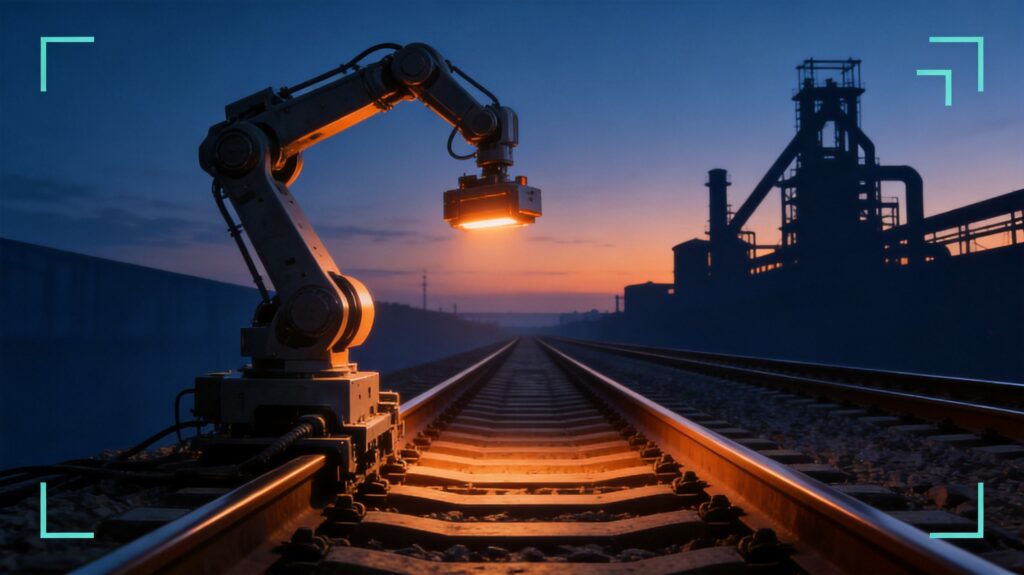
The solution that’s gaining traction across forward-thinking rail operators is simple in concept but sophisticated in execution: let robots do the repetitive, dangerous, precision-dependent work, and let human workers focus on oversight, planning, and complex problem-solving.
The iRunYu Rail Track Bolt Oiling Robot, developed by Run&Win, represents this new approach. It’s not just a machine that applies grease — it’s an intelligent maintenance system that combines three key technologies:
1. AI Visual Recognition
Using deep learning algorithms trained on thousands of track images, the iRunYu robot’s vision system identifies individual bolt positions with ≥95% accuracy — even when bolts are rusted, dirty, or partially covered by debris. This isn’t simple pattern matching; it’s true AI recognition that adapts to real-world track conditions.
2. High-Pressure Precision Spraying
Once a bolt is detected, a high-pressure spray system delivers a precisely metered volume of standard industrial grease — no dilution required. The atomized spray coats the entire bolt head and threaded area evenly, ensuring consistent corrosion protection that outlasts hand-applied grease.
3. BeiDou-Precision Positioning & IoT Reporting
Every bolt the robot services is geotagged via BeiDou/GNSS high-precision positioning. The result is a complete digital record of maintenance activity — which bolts were serviced, when, with how much grease, and where exactly they are on the network. This data flows into a cloud-based management platform, giving maintenance teams unprecedented visibility into their operations.
Real-World Impact: What Automated Bolt Oiling Delivers
The numbers tell a compelling story. Rail operators that have adopted automated bolt oiling technology are seeing:
- Dramatic efficiency gains. A single autonomous robot can cover far more track per shift than a manual crew — and keep working steadily without fatigue. For operators managing hundreds or thousands of track kilometers, this translates to fewer maintenance cycles and more consistent coverage.
- Improved quality and consistency. When every bolt receives the same calibrated amount of grease in the same position, you eliminate the variability that leads to premature corrosion. The result: extended bolt service life, fewer replacements, and lower long-term maintenance costs.
- Data-driven decision making. Instead of relying on paper logs and subjective assessments, maintenance managers get hard data: exactly which track sections were serviced, how many bolts were treated, total grease consumption, and more. This enables better planning, budgeting, and compliance reporting.
- Enhanced worker safety. Every hour a robot spends trackside is an hour a human worker doesn’t. In an industry where safety is paramount, reducing worker exposure to trackside hazards is both an ethical imperative and a cost saver.
The Bigger Picture: AI and the Future of Railway Infrastructure
Automated bolt oiling is just the beginning. The same technology stack — AI vision, precision robotics, IoT data connectivity — is being applied to a growing range of railway maintenance tasks, from AI track inspection and predictive maintenance to autonomous geometry measurement and digital twin integration.
As these technologies mature and converge, we’re moving toward a future where railway maintenance is not just reactive — or even proactive — but predictive and autonomous. Sensors and robots will continuously monitor and maintain track condition, while human experts focus on strategy and complex decision-making.
Conclusion
The railway industry has always been defined by innovation. But the next wave of rail transformation won’t come from faster trains alone — it will come from smarter maintenance.
AI-powered robotics like the iRunYu Rail Track Bolt Oiling Robot represent a fundamental shift in how we care for critical infrastructure: safer, more efficient, more data-driven, and more sustainable.
For rail operators, the question is no longer whether to adopt automated maintenance technology — it’s how quickly they can implement it, and how much they stand to gain.
Ready to explore how AI-powered rail maintenance can transform your operations?
Learn more about the iRunYu Rail Track Bolt Oiling Robot →
Run&Win — Pioneering AI robotics for critical infrastructure inspection and maintenance.
Run&Win Engineering Team
AI robotics specialists building the future of infrastructure inspection and maintenance.
⏱️ 6 min read
🏷️ Rail Technology
Related Products & Articles
Discover more about how AI robotics is transforming critical infrastructure.
E1 Underwater Inspection ROV
Professional-grade underwater inspection robot with AI-powered vision for dams, bridges, marine infrastructure, and more.
Rail Track Bolt Oiling Robot
Autonomous rail maintenance robot that inspects and oils track bolts with precision — reducing manual labor and improving rail safety.
Ready to Transform Your Rail Maintenance?
Talk to our team about your specific use case. We’ll help you find the right robotic solution — fast.
© 2026 Run&Win. All rights reserved.