
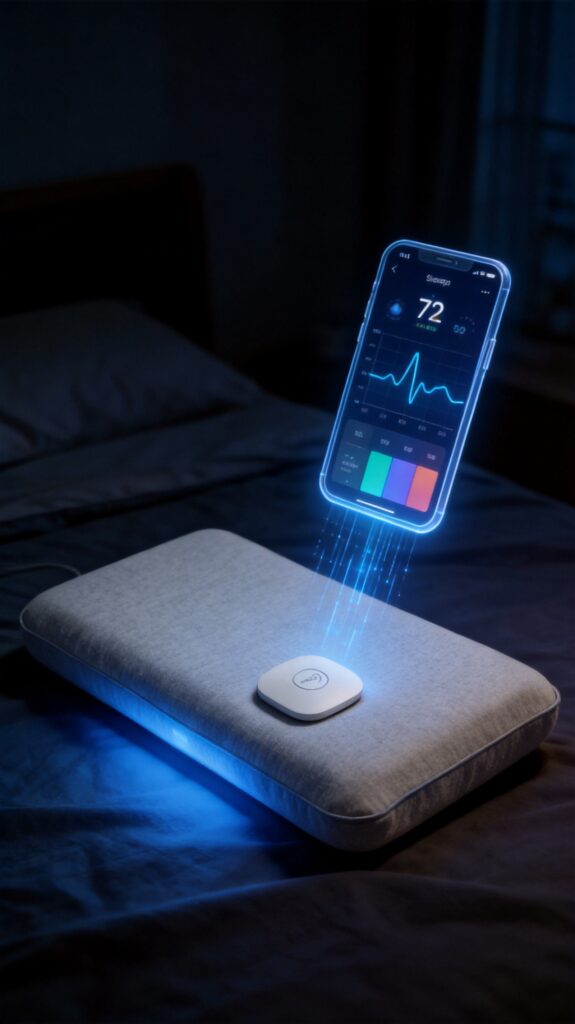
AI Sleep Monitoring: How Smart Pillows Are Revolutionizing Healthcare at Home
Sleep is the foundation of good health — yet millions of people struggle with undiagnosed sleep disorders, poor sleep quality, and the long-term health consequences that follow. Traditional sleep monitoring requires overnight stays in sleep labs, expensive equipment, and uncomfortable wired setups. But AI-powered smart sleep technology is changing all that.
Today, medical-grade sleep monitoring is available right on your bed, in the form of smart pillows that use AI algorithms and fiber-optic sensing technology to track your sleep with remarkable accuracy. In this article, we’ll explore how AI sleep monitoring works, why it matters for preventive healthcare, and what to look for in a smart pillow solution.
In This Article
- The Sleep Health Crisis: Why Monitoring Matters
- How AI Sleep Monitoring Technology Works
- Key Health Metrics Tracked by Smart Pillows
- Benefits of At-Home Sleep Monitoring
- Who Can Benefit Most
- Choosing the Right Smart Pillow
- The Future of AI-Powered Sleep Healthcare
The Sleep Health Crisis: Why Monitoring Matters
According to the World Health Organization, sleep disorders affect approximately 30% of the global population. The American Sleep Apnea Association estimates that 22 million Americans suffer from sleep apnea — and 80% of cases go undiagnosed.
Untreated sleep disorders can lead to serious health complications:
- Cardiovascular disease: Chronic sleep deprivation raises blood pressure and increases the risk of heart attacks and strokes
- Metabolic disorders: Poor sleep disrupts insulin sensitivity and contributes to type 2 diabetes
- Mental health: Sleep problems are closely linked to anxiety, depression, and cognitive decline
- Workplace safety: Fatigue-related accidents cost billions annually in lost productivity
The problem with traditional sleep diagnostics is accessibility. Polysomnography (PSG) — the gold standard for sleep testing — requires an overnight stay at a sleep center, costs thousands of dollars, and often produces data from just one night of sleep that may not be representative of a patient’s typical patterns.
How AI Sleep Monitoring Technology Works
Modern smart pillows like the H-Guard Smart Sleep Monitoring Pillow use advanced sensing technology combined with AI algorithms to deliver clinical-grade sleep analysis from the comfort of home.
1. Fiber-Optic Ballistocardiography (BCG)
At the heart of premium smart pillows is fiber-optic sensing technology. Ultra-thin optical fibers woven into the pillow detect the subtle mechanical forces generated by your heartbeat, breathing, and body movements — all without any electrodes, wearables, or direct skin contact.
These sensors capture the ballistocardiogram (BCG), a measure of the body’s mechanical response to cardiac ejection. When your heart pumps blood, the slight recoil of your body creates measurable vibrations that the fiber-optic sensors pick up with remarkable precision.
2. AI Signal Processing
Raw sensor data is processed by AI algorithms trained on millions of hours of sleep data. These algorithms can:
- Identify sleep stages (awake, light, deep, REM) with high accuracy
- Detect abnormal respiratory patterns like apnea events
- Measure heart rate variability (HRV) as a stress indicator
- Track body position changes throughout the night
- Generate personalized sleep quality scores
3. Personalized Sleep Insights
Beyond raw data tracking, AI-powered systems analyze your sleep patterns over time to provide personalized insights and recommendations. The system learns your unique sleep profile and can identify trends, suggest lifestyle adjustments, and flag potential issues that may warrant medical attention.
Key Health Metrics Tracked by Smart Pillows
A quality AI sleep monitoring pillow tracks a comprehensive set of health metrics:
Sleep Architecture
- Sleep stages: Time spent in light, deep, and REM sleep
- Sleep latency: How long it takes to fall asleep
- Sleep efficiency: Percentage of time in bed actually spent sleeping
- Wake after sleep onset (WASO): Time awake during the night
Cardiovascular Indicators
- Heart rate: Real-time and average heart rate during sleep
- Heart rate variability (HRV): A key indicator of autonomic nervous system health
- Irregular heartbeat detection: Early warning for potential arrhythmias
Respiratory Health
- Respiratory rate: Breathing frequency during sleep
- Respiratory pattern analysis: Detection of irregular or labored breathing
- Apnea events: Identification of breathing pauses (critical for sleep apnea screening)
- Snoring detection: Frequency and severity of snoring episodes
Body Position & Movement
- Sleep position tracking: Back, side, or stomach sleeping
- Movement frequency: Restlessness indicator
- Posture-based insights: Position-related apnea or breathing issues
Benefits of At-Home Sleep Monitoring
Early Detection of Health Issues
One of the most significant benefits is early detection. Many sleep-related conditions develop gradually over months or years. Continuous at-home monitoring can detect subtle changes in sleep patterns that may indicate emerging health problems — long before symptoms become obvious to the individual or their doctor.
Better Data for Healthcare Providers
A single night in a sleep lab provides limited data. With at-home AI monitoring, clinicians get weeks or months of real-world sleep data in the patient’s natural sleep environment. This longitudinal data often provides a more accurate picture than isolated lab tests and can help doctors make better-informed treatment decisions.
Cost and Accessibility
Smart pillows cost a fraction of traditional sleep studies and are available to anyone without a prescription. This democratization of sleep monitoring means that people in underserved areas, older adults with mobility challenges, and those with busy schedules can all access quality sleep health data.
Motivation for Lifestyle Changes
Seeing your sleep data day after day is a powerful motivator. Most users find that tracking their sleep naturally leads to better sleep hygiene habits — consistent bedtimes, reduced screen time before bed, and improved sleep environments. The feedback loop created by AI monitoring drives real behavioral change.
“AI sleep monitoring isn’t just about tracking numbers — it’s about giving people the insights they need to take control of their sleep health, one night at a time.”
Who Can Benefit Most
Older Adults
As we age, sleep quality often declines, and the risk of sleep-related health issues increases. Smart pillows provide non-intrusive monitoring that’s particularly valuable for seniors who may find wearable devices uncomfortable or difficult to operate.
People with Chronic Health Conditions
Those with hypertension, diabetes, cardiovascular disease, or respiratory conditions can benefit from understanding how their sleep affects their condition — and vice versa. The data can also be shared with healthcare providers for more comprehensive care.
Athletes and Fitness Enthusiasts
Sleep is critical for athletic performance and recovery. Elite athletes and fitness-focused individuals use sleep monitoring to optimize recovery, adjust training loads, and prevent overtraining. HRV data, in particular, provides valuable insights into readiness and recovery status.
Health-Conscious Individuals
Anyone interested in proactive health management can benefit from understanding their sleep patterns. Sleep is one of the pillars of health — alongside nutrition and exercise — and optimizing it can have profound effects on energy, mood, and overall wellbeing.
Choosing the Right Smart Pillow
With the growing market for sleep tech, it’s important to choose a product that delivers real value. Here’s what to look for:
1. Medical-Grade Accuracy
Not all smart pillows are created equal. Look for products that use clinically validated sensing technology — like fiber-optic BCG — rather than basic accelerometers. The H-Guard Smart Sleep Monitoring Pillow uses medical-grade fiber-optic sensing validated against polysomnography standards.
2. Comfort Comes First
A smart pillow needs to be a great pillow first and a smart device second. If it’s not comfortable, you won’t use it consistently. Look for adjustable firmness, breathable materials, and ergonomic support.
3. Privacy and Data Security
Your health data is sensitive. Make sure the product you choose has strong privacy protections, secure data encryption, and transparent data handling policies. You should own and control your health data.
4. App Quality and Insights
The hardware is only half the story. The companion app should provide clear, actionable insights — not just raw numbers. Look for trend analysis, personalized recommendations, and easy-to-understand reporting.
5. No Wearables Required
The best sleep monitors require nothing to wear or charge. Contact-free sensing means you just sleep normally on your pillow — no bands, no watches, no nightly charging. It’s the most natural way to track sleep.
The Future of AI-Powered Sleep Healthcare
We’re at the beginning of a revolution in at-home health monitoring. AI sleep technology is advancing rapidly, and future developments will likely include:
- Predictive health alerts: AI algorithms that can detect early signs of conditions like atrial fibrillation or neurodegenerative diseases
- Telemedicine integration: Seamless sharing of sleep data with healthcare providers for remote monitoring
- Adaptive sleep environments: Smart pillows that communicate with smart beds, thermostats, and lighting to optimize sleep conditions in real-time
- Population health insights: Aggregated anonymized sleep data contributing to public health research
- Integrative health platforms: Sleep data combined with nutrition, exercise, and mental health data for whole-person health management
As AI algorithms continue to improve and sensor technology becomes more sophisticated, smart pillows will evolve from “nice-to-have” gadgets to essential health monitoring tools — as common in households as thermometers or blood pressure cuffs are today.
Final Thoughts
AI sleep monitoring represents a significant leap forward in preventive healthcare. What once required an overnight hospital stay and thousands of dollars is now available in the form of a comfortable, easy-to-use smart pillow.
Whether you’re managing a chronic condition, optimizing athletic performance, or simply taking a proactive approach to your health, AI-powered sleep monitoring provides the data and insights you need to understand and improve one of the most fundamental pillars of wellness: a good night’s sleep.
Ready to take control of your sleep health? Explore the H-Guard Smart Sleep Monitoring Pillow — medical-grade AI sleep monitoring in a premium memory foam pillow.
Discover H-Guard Smart Sleep Pillow
Medical-grade AI sleep monitoring with fiber-optic sensing technology. Track heart rate, respiratory rate, sleep stages, and more — all without wearables.